




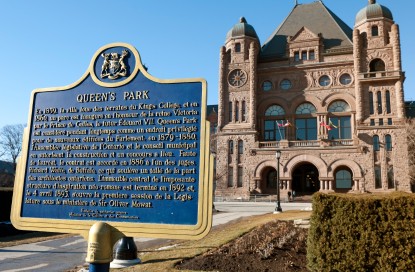
The Employment Standards Act, 2000 is provincial legislation which is only applicable to employees who are working within Ontario’s jurisdiction and not for the stated industries listed in the Canadian Labour Code. For more information on which employees are included or excluded from the provisions of the ESA, 2000, see Employment Standards Act, 2000 vs. Canadian Labour Code.
This article outlines some of the key sections of the ESA, 2000 which deal with the most common areas involving employment standards, including:
- Hours of Work
- Leaves of Absence—Pregnancy, Parental, Personal Emergency, Family Medical
- Public Holidays
- Notice or Pay in Lieu of Notice on Termination
- Severance on Termination
- Minimum Wages
- Minimum Ages
Please note that the following does not necessarily apply to workplaces regulated by federal statutes.
Hours of Work
Most employees are subject to the conditions below. However, there are a number of exceptions which are explained later in this section.
| Maximum required hours of work: | 8.00 hours per day, or 48.00 hours per week |
| Hours requiring overtime pay: | Hours worked in excess of 44.00 hours per week |
| Overtime rate: | 1 and 1/2 times the employee’s regular rate of pay |
| Meal break period: | 1/2 hour for every 5.00 consecutive hours worked |
| Coffee break: | No requirement |
| Rest Period between work shifts: | 11 consecutive hours in a 24 hour period; and 24 consecutive hours each week or, 48 consecutive hours every two weeks. |
Altering Work Hours Standards
Employers and employees can agree in writing to extend the maximum hours of work, up to 60 hours per week. However, the employer must have first applied for and been issued an approval of such an increase by the Director of Employment Standards at the Ontario Ministry of Labour.
If an employer has applied for such an increase but has not received a reply from the Director of Employment Standards within 30 days, then an employee can begin to work up to a maximum of 60 hours per week.
Employees Exempt from Overtime Pay
Not all employees are entitled to overtime pay. Most managers and supervisors do not qualify for overtime pay if the work they perform is managerial or supervisory, and they perform non-managerial or non-supervisory tasks on an irregular or exceptional basis.
Where an employee’s character of employment is managerial in nature but whose duties regularly involve non-managerial work as part of his/her employment, then the employee is entitled to overtime pay.
For more information, refer to the Employment Standards Act, 2000 in order to determine whether a certain type of employment is entitled to overtime pay.
Leaves of Absence
Employees are entitled to certain amounts of time off from work for various reasons. The following tables outline the minimum amount of time off that employers must provide to employees on the various types of leaves, as well as the amount of time the employee must be employed with the employer before qualifying for such leaves, and the amount of notice the employee must provide the employer before taking leave.
Pregnancy Leave
Parental Leave
Personal Emergency Leave
Family Medical Leave
Holidays
Employees are entitled to time off or pay in lieu of public holidays. Aside from the common paid holidays listed below, other holidays may include Simcoe Day, Easter Sunday and Remembrance Day. However, these are not paid public holidays, although Easter Sunday and other holidays as declared by the Lieutenant Governor are also covered by the Retail Business Closing Act. Ontario’s ten public holidays are as follows:
| New Year’s Day |
| Family Day |
| Good Friday |
| Victoria Day |
| Canada Day |
| Labour Day |
| Thanksgiving Day |
| Christmas Day |
| Boxing Day |
Notice or Pay In Lieu of Notice on Termination
The following are standard minimums for notice owed to individually terminated employees. Please note that notice provisions under common law often exceed statutory minimums.
| Length of Employment | Minimum Notice Required |
| Under 3 months | None |
| Between 3 months and under 1 year | 1 week |
| 1 year or more and fewer than 3 years | 2 weeks |
| 3 year or more and fewer than 4 years | 3 weeks |
| 4 year or more and fewer than 5 years | 4 weeks |
| 5 year or more and fewer than 6 years | 5 weeks |
| 6 year or more and fewer than 7 years | 6 weeks |
| 7 year or more and fewer than 8 years | 7 weeks |
| 8 years or more | 8 weeks |
Special rules apply in the case of “mass terminations”, where 50 or more employees are terminated at an employer’s establishment within a four-week period.
Severance on Termination
Oftentimes, a “termination package” will use the terms “notice” (“pay in lieu of notice” or “termination pay”) and “severance” interchangeably, although they are technically distinct. In certain circumstances, severance may be owed in addition to termination pay depending on the company’s annual payroll and on how long the employee worked for the company.
For more information, see “Severance Pay—Not the Same as Termination Pay”
Minimum Wages
Employees are entitled to a minimum amount of pay per hour depending on the nature of work performed.
There are also maximum amounts chargeable to employees for accommodations and meals when these are taken into account to establish minimum wage.
Minimum Age
In Ontario, children over the age of 14 are allowed to work as employees in certain establishments. However, between the ages of 14-17, children are required to attend school and cannot be employed during school hours.
| Age (under) | Restricted Work |
| 14 | Industrial work, stores, offices, arenas, restaurant serving areas |
| 15 | Restaurant kitchens, warehouses, produce and meat preparation, laundries, shipping/receiving areas, automotive service garages |
| 16 | Logging operations, construction projects, mining plants or surface mines |
| 18 | Underground mines or working face of surface mines, window cleaning |
For related case studies and more information on Employment Standards Act, 2000, search our blog or visit:
Ontario Ministry of Labour
Work Smart Ontario
Service Ontario e-Laws